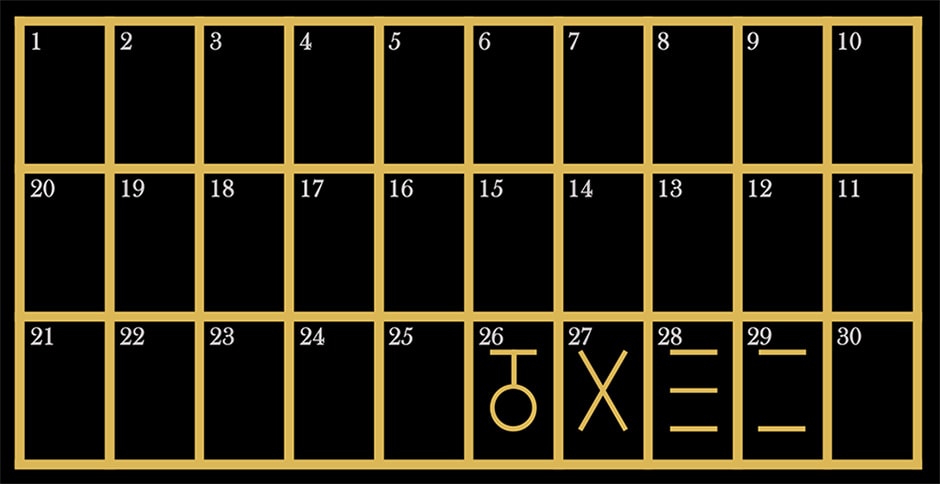
Traditional Senet board with thirty squares arranged in three rows of ten

A typical Senet board: three rows of ten squares with special marked houses towards the end of the track.

Senet Rules

Senet is one of the oldest known board games, played in ancient Egypt by all social classes and even depicted in funerary texts as a pastime of the afterlife. Because no complete rulebook survives, modern Senet is played using reconstructed rules that aim to capture the feel of a fast, tactical race game with a spiritual flavour.

Ancient Egyptian game Two-player race Split reed dice Afterlife symbolism

Quick setup checklist

  • Place the board between the players so that both can follow the track in the same direction.
  • Arrange the counters in an alternating pattern along the first ten squares: white on odd-numbered squares, black on even-numbered squares.
  • Keep the split reeds within reach of both players and agree that moves are taken in the direction of ascending square numbers.

Game equipment and setup

A standard Senet set is compact and simple, consisting of a small board, matched counters, and special throwing sticks or split reeds instead of conventional dice.

  • A rectangular board of thirty squares, usually arranged in three rows of ten, forming a continuous snaking track.
  • Ten counters in total: five light (white) and five dark (black), one colour per player.
  • Four split reed dice, each with a flat and a curved side. The number of curved sides facing upwards after a throw determines the move value:
    • One curved side up = 1 point.
    • Two curved sides up = 2 points.
    • Three curved sides up = 3 points.
    • Four curved sides up = 4 points.
    • All four flat sides up = 6 points.

Who moves first?

Both players throw the reeds. They repeat until exactly one player throws a value of 1. That player takes the black counters and immediately moves the black piece from square 10 to square 11, then continues to play black until they first throw a 2 or 3.

When the first player finally throws a 2 or 3, the turn passes. The opponent takes the white counters and opens by moving the white counter from square 9. White, too, keeps rolling and moving any legal white counter until they throw a 2 or 3.

After the opening, turns alternate between players. On your turn you roll, then choose one of your counters to move exactly that many squares if a legal move exists.

Starting position and turn order

At the beginning of the game, the first row (squares 1–10) is filled in an alternating pattern: white counters on squares 1, 3, 5, 7, and 9; black counters on squares 2, 4, 6, 8, and 10.

The objective is to be the first player to move all of your counters along the track and off the end of the board.

Movement and blocking

Once the opening is complete, turns are simple: throw the reeds, then move a single counter along the track if you can.

  • A counter moves forward along the numbered squares by exactly the value shown on the throw. It may never land on a square occupied by another counter of the same colour.
  • If a counter lands on a square occupied by an enemy counter, the pieces usually swap positions: your piece takes the square and the opposing piece moves back to your original square.
    • Two adjacent enemy counters form a safe pair. You may not move onto either square to swap; both pieces are protected from capture.
    • Squares 26, 28, 29, and 30 are refuge squares. Landing on them does not allow a swap; enemy pieces here cannot be captured by swapping.
  • You may not move a piece so that it passes beyond a block of three consecutive squares, all occupied by enemy counters. This wall cannot be jumped.
  • If you land exactly on square 27 (marked with an X in many reconstructions), your counter must then move to the lowest-numbered unoccupied square on the board.

If you have at least one legal move, you must take one. If no counter can be moved legally with the throw, your turn is lost and play passes to your opponent.

Following the track

The thirty squares are typically numbered from 1 to 30 in a snaking pattern: the first row runs 1–10 from left to right, the second row 11–20 from right to left, and the third row 21–30 from left to right again.

Counters always move along this sequence in ascending order, never backwards, until they reach the final squares where they can be borne off.

Named houses in traditional iconography

  • Square 26 is known as the House of Happiness. In some reconstructions, you must land on this square exactly before you are allowed to progress onto the final four squares.
  • Square 27 is the House of Water in many versions. Instead of dropping to the lowest unoccupied square, some rules send the counter back specifically to square 15.
  • Square 15 is often called the House of Rebirth, representing a return from the waters of chaos back into play.

Special houses and refuge squares

Towards the end of the track, several squares are marked and treated as special houses, giving Senet a more tactical and symbolic character.

  • Squares 26, 28, 29, and 30 are often treated as refuge squares. Pieces sitting on them cannot be captured by a simple swap move.
  • Combined with blocking rules, these refuges create bottlenecks near the end of the course, where a few pieces can slow the opponent significantly.
  • Square 27 is usually marked separately (often with an X). Landing here forces your piece to move back to the lowest unoccupied square, acting as a setback or penalty in this rule set.

Ending the game and bearing off

The race is won by the first player to remove all of their counters from the board, but bearing off is restricted by position.

  • You may only start bearing off once all of your remaining counters are on the third row (squares 21–30).
  • Under the basic rule, a counter is removed by moving it the exact number required to land on square 30 from its current position.

Scoring the win

The simplest way to play is that the first player to remove all of their counters from the board simply wins. However, you can also assign a score based on how far the losing pieces have progressed.

  • Each enemy counter still on the third row (squares 21–30) scores 3 points for the winner.
  • Each enemy counter on the second row (squares 11–20) scores 2 points for the winner.
  • Each enemy counter on the first row (squares 1–10) scores 1 point for the winner.

Alternative exit rules

Some modern rule sets refine the final stage by allowing different exit rolls depending on how far along the last row a counter has travelled.

  • From square 28, a counter may exit the board with a throw of 3.
  • From square 29, a counter may exit the board with a throw of 2.
  • From square 30, a counter may exit the board with a throw of 1.

Rule variations

Because the historical rules of Senet are incomplete, many different modern reconstructions exist. Most keep the same track and equipment but adjust how special houses work, how far pieces are sent back, and exactly how bearing off is handled. You can adopt the version that feels most intuitive and even create house rules for repeated play.

Bringing Senet to the table

Once you are comfortable with a basic rule set, Senet becomes a quick, tense race game with strong positional tactics around the special houses. It works well as a short companion to deeper games, and its ancient Egyptian theme makes it a striking addition to any board game collection.

Our unique tool uses AI to show you chess sets that are right for you.

Describe what you're looking for...

Try: Staunton set for 50 cm board Luxury gift under £200
Press ENTER to search.