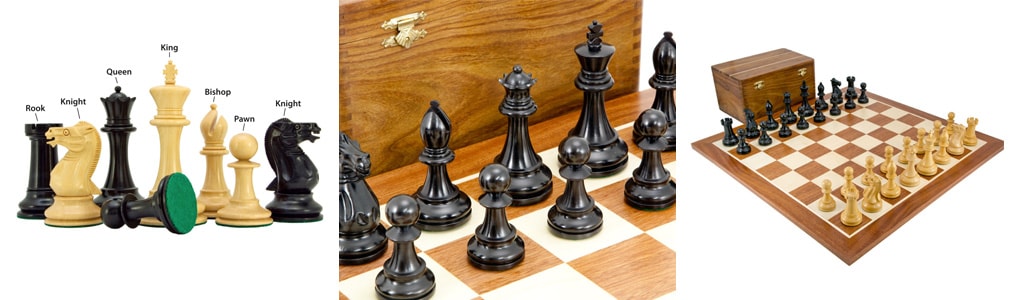
A standard chessboard with 32 pieces arranged in their starting position.
Chess is a game of pure strategy, played on a 64-square board by two players of any level, from complete beginner to Grandmaster. Before you explore openings and tactics, it helps to understand how the pieces move, how check and checkmate work, and when a game can end in a draw.
A chessboard has 64 squares arranged in an 8×8 grid, with alternating light and dark squares. The board is placed so that each player has a light square on their right-hand corner.
Each side has 16 pieces: 1 King, 1 Queen, 2 Rooks, 2 Bishops, 2 Knights and 8 Pawns. The back rank (closest to each player) is set up from left to right: rook, knight, bishop, queen, king, bishop, knight, rook. The queen goes on a square of her own colour (white queen on a light square, black queen on a dark square). All eight pawns are placed directly in front of the main pieces.
Players move one piece at a time, taking turns, with White always moving first. Pieces capture by moving to a square occupied by an opposing piece and removing it from the board. Kings may never move into check.
King: moves one square in any direction (horizontally, vertically, or diagonally). The king cannot move into check and cannot stand on an adjacent square to the opposing king.
Queen: moves any number of squares along a rank, file, or diagonal. It may not jump over other pieces.
Rook: moves any number of squares horizontally or vertically, without jumping. Rooks are also involved in the special castling move with the king.
Bishop: moves any number of squares diagonally. Each bishop always remains on the same colour of square it starts on.
Knight: moves in an “L” shape: two squares in one direction and then one square perpendicular to that, or vice versa. Knights can jump over any pieces that stand between their starting and ending squares.
Pawn: normally moves one square straight forward without capturing. On its very first move it may advance two squares, if both squares are empty. Pawns capture diagonally forward one square and never move or capture backwards.
In addition to their normal movement, there are three important special rules in chess.
Castling: once per game, a king may castle with a rook on the same side. The king moves two squares towards the rook and the rook moves to the square the king crossed. Castling is only allowed if neither the king nor rook has moved before, the squares between them are empty, the king is not in check, and the king does not move through or into check.
En passant: if a pawn moves two squares forward from its starting rank and lands beside an opposing pawn, that opposing pawn may capture it as if it had only moved one square. This capture must be made immediately on the very next move or the right is lost.
Promotion: when a pawn reaches the farthest rank (the eighth rank for White, first rank for Black), it must be promoted to a queen, rook, bishop, or knight of the same colour. Most players choose a queen.
A king is in check when it is under direct attack by one or more enemy pieces. The player whose king is in check must immediately respond to the threat.
Not every game ends in checkmate. Chess can also end in a draw in several ways:
Prefer a printable reference alongside your board? You can download a concise PDF version of these rules.
Once you know how the pieces move, the next step is finding a chess set you enjoy playing on. Whether you prefer traditional Staunton pieces, themed sets, or luxurious wooden boards, there is a perfect combination for every player.
Get 15% off your order when you sign up.